
Written By Alyssa Henry – Laboratory Analyst I
What Is Bubble Leak Testing?
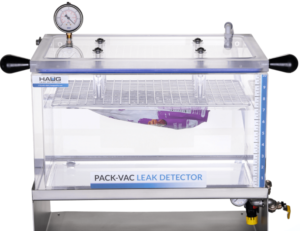 Bubble leak testing is a physical method for detecting leaks in packaging. The basic principle is simple: if air is forced through a defect while the package is surrounded by liquid, escaping air can form visible bubbles. The method is useful because it provides a direct visual indication of a leak without requiring highly specialized leak detection equipment. However, it’s worth noting that bubble leak testing is generally intended for gross leak detection, rather than extremely small leaks. The actual defect size that can be detected by bubble leak testing depends on the package, material, product, pressure or vacuum conditions, and test parameters. Still, bubble leak testing is one of the most straightforward ways to check a package for leaks and in some cases, the most appropriate for the package. By creating a pressure difference and observing whether air escapes through a defect, the test can reveal visible bubbles that indicate a leak.
Two ASTM standards commonly associated with bubble leak testing are ASTM D3078 and ASTM F2096. Both of these methods are considered FDA consensus standards for medical device packaging and are referenced in ISO 11607 Requirements for Terminally Sterilized Medical Devices. They can also have applications in the pharmaceutical and biotech sectors. Although both methods use bubbles to detect leaks, they are not interchangeable, nor are they suitable for all leak test applications.
The biggest difference is how the pressure difference is created. ASTM D3078 places a flexible package in a vacuum chamber, while ASTM F2096 introduces internal air pressure into the package. Understanding this difference is important when deciding which method is appropriate for a specific package.
ASTM D3078: Bubble Emission by Vacuum
ASTM D3078, Standard Test Method for Determination of Leaks in Flexible Packaging by Bubble Emission, is specifically intended for flexible packaging which contains enough headspace gas to produce detectable bubble formation when placed under vacuum. The package is placed in a transparent vacuum chamber containing an immersion fluid and fully submerged. A vacuum is then drawn around the package, creating a pressure differential between the package interior and the liquid-filled vacuum chamber. The package is inspected for leaks as evidenced by a steady stream of bubbles emanating from a defects. In the presence of a leak, gas can escape through the defect and form bubbles in the surrounding liquid, which can be readily observed. At the end of the test, the location of the observed defect may be circled and further inspected
The ASTM notes that small leaks may not be detected, and that results can be affected by the product, packaging material, and test parameters. Trapped air on or in packaging materials may come out under test. Additionally, product behavior can interfere with testing. Entrapped air, viscous products, or product plugging at a small opening can all prevent gas from passing through the defect. For that reason, D3078 should not automatically be considered a highly sensitive leak test for all applications.
ASTM F2096: Bubble Test by Internal Pressurization
ASTM F2096, Standard Test Method for Detecting Gross Leaks in Packaging by Internal Pressurization (Bubble Test), uses a different approach. Instead of pulling a vacuum around the package, air is introduced into the submerged package to create internal pressure. The package is then examined for bubbles indicating a leak.
Although F2096 can be applied to many types of packages, it is particularly useful for flexible medical packaging, including tray and pouch configurations. It can also be useful for large or long packages that may not fit conventional package integrity testing equipment. The method can detect gross leaks as well as substrate holes and channels, and the ASTM identifies a sensitivity down to approximately 250 µm with an 81% probability under the conditions described by the standard.
One downside to this method is that the method is destructive, since the package must be punctured in some way to introduce internal air pressure. The ASTM also notes that the sensitivity has not been evaluated for all porous materials or for nonporous packaging, so the standard should not simply be applied to a different package type without appropriate evaluation.
ASTM D3078 vs ASTM F2096
| Factor | ASTM D3078 | ASTM F2096 |
|---|---|---|
| Primary principle | Vacuum around package | Internal pressurization |
| Package type | Flexible packaging with headspace gas | Flexible packages, including trays and pouches |
| Leak type | Gross leaks | Gross leaks, substrate holes and channels |
| Typical application | Flexible packaging | Medical and flexible packaging |
| Test setup | Package immersed in liquid inside vacuum chamber | Package internally pressurized and examined for bubbles |
| Destructive? | Typically requires testing in a vacuum chamber; package may be compromised depending on configuration | Yes, requires access to package interior |
| Sensitivity | Limited for small leaks; affected by product and package characteristics | Down to approximately 250 µm with 81% probability under specified conditions |
| Major limitation | Requires suitable headspace; small leaks may be blocked by product | Requires access for pressurization and is not evaluated for all package materials |
The key takeaway is that D3078 is a vacuum-based bubble emission test, while F2096 is an internally pressurized bubble test.
When Should You Use Each Method?
ASTM D3078 may be a good choice when evaluating a flexible package containing headspace gas and a vacuum-chamber setup is practical. It can be useful for identifying gross leaks without having to pressurize the package internally.
ASTM F2096 may be more appropriate when the package can be accessed and internally pressurized, particularly for medical trays, pouches, and larger or unusually shaped flexible packages.
The important point is that neither ASTM method is universally better. The appropriate method is the one that can reliably detect relevant defects in the actual package while meeting the requirements of the test. Neither method should be selected based on sensitivity alone. The package construction and test objective should drive the decision.
Common Bubble Leak Testing Errors
Several factors can lead to misleading results. Incorrect vacuum or pressure can change the test response and affect sensitivity. Misinterpreting bubbles can also create false positives, particularly when bubbles result from trapped air or permeation rather than a package leak. Channel leaks should not be overlooked because a leak may occur along a seal rather than through an obvious hole. Product residue or contamination can also interfere with the test by blocking small defects or effecting the immersion fluid. Test conditions should, therefore, be controlled carefully. The package, test fluid, temperature, pressure or vacuum, exposure time, and inspection criteria should be established during method development and supported by appropriate validation.
Best Practices for Bubble Leak Testing
Start with the package: understand its material, construction, seal design, contents, and potential failure modes before selecting the ASTM method. Use appropriate positive and negative controls, establish relevant defect sizes, and control test conditions consistently. Most importantly, an ASTM method should be treated as a standardized test procedure, not a substitute for package-specific method development and validation. The test needs to demonstrate that it can detect defects relevant to the actual packaging system.
Frequently Asked Questions
Is ASTM D3078 the same as ASTM F2096?
No. Both use bubble emission to detect gross leaks, but D3078 uses a vacuum chamber around the package while F2096 internally pressurizes the package.
Which is more sensitive, D3078 or F2096?
They should not be compared by a single sensitivity value because the methods use different test principles and their performance depends on package and test conditions. F2096 specifies detection down to approximately 250 µm with an 81% probability under its defined conditions. D3078 has a defined sensitivity limited to approximately 1 × 10⁻⁵ atm⋅cm³/s (or 1 × 10⁻⁶ Pa⋅m³/s), and it can often be even less sensitive depending on testing conditions.
Are bubble leak tests destructive?
F2096 is destructive because the package must be accessed for internal pressurization. D3078 may also be destructive depending on the package and test configuration, but involves the use of a vacuum chamber.
Can bubble testing detect microscopic leaks?
Bubble testing is generally intended for gross leak detection. Small leaks may not produce detectable bubbles, and factors such as product viscosity, trapped air, package material, and test conditions can affect detection.
Conclusion
ASTM D3078 and ASTM F2096 are both useful bubble leak testing methods, but they approach leak detection differently. Choosing between them starts with the package and the purpose of the test. By understanding the differences in test setup, packaging limitations, defect detection, and sensitivity, manufacturers can select the bubble leak method that is most appropriate for their specific application.